U-Value Calculations
Thermal transmittance reports for walls, floors and roofs — calculated layer by layer to prove your building fabric meets Part L, and to feed directly into your SAP or SBEM assessment.
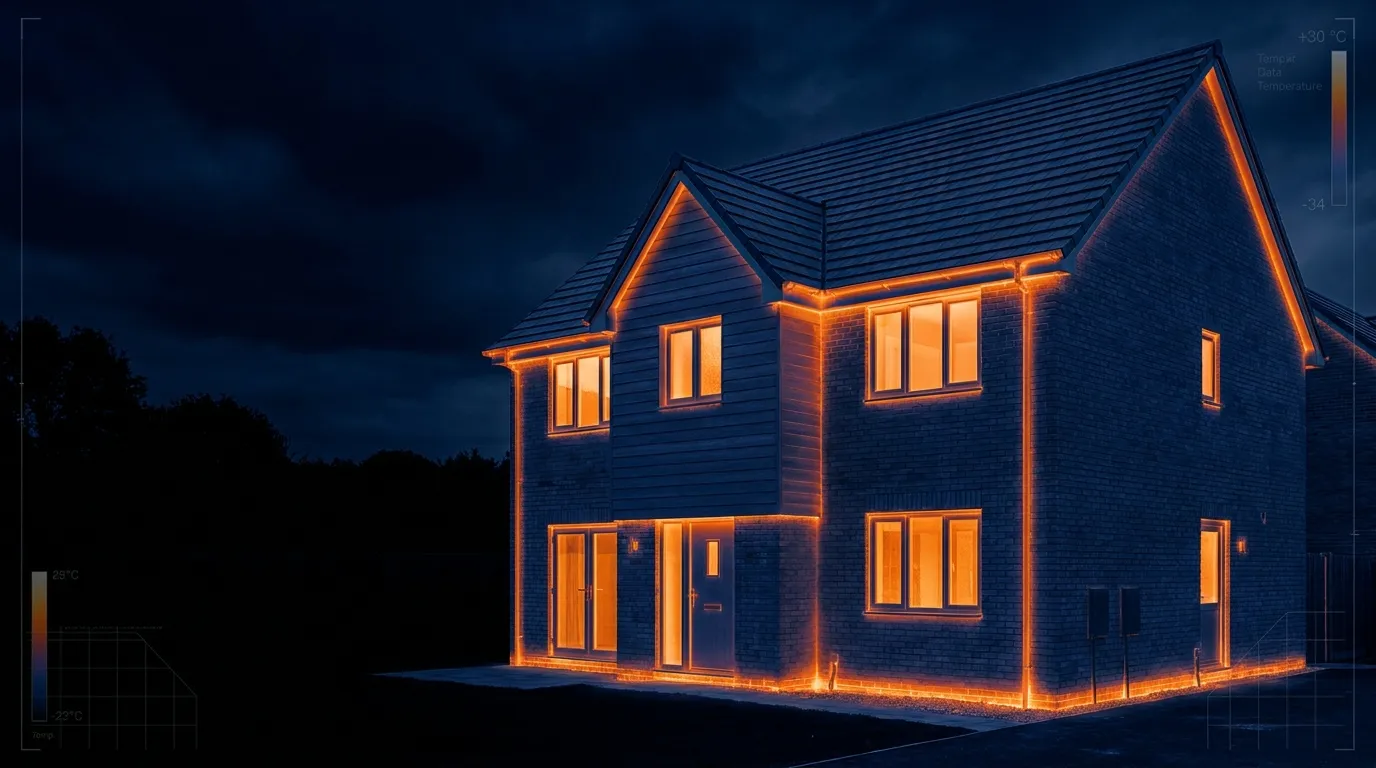
A U-value measures the rate of heat transfer through an element of a building’s fabric — an external wall, ground floor or roof — expressed in W/m²K (Watts per square metre Kelvin). It quantifies exactly how much heat escapes from inside to outside: the lower the U-value, the better insulated that element is.
To calculate a U-value accurately, we analyse the thermal conductivity and thickness of every individual layer in your build-up — internal plasterboard, insulation, cavity air gaps, external brickwork, and the minor thermal bridges caused by wall ties or timber studs. The resulting figures feed directly into your SAP Calculations, Home Energy Model or SBEM Calculations, and give Building Control the evidence they need under Part L.
Every fabric element, calculated to Part L.
External wall U-values
Masonry, timber and steel-frame wall build-ups calculated layer by layer, accounting for cavity air gaps and the repeating thermal bridges of wall ties and studs.
Floor U-values
Ground, exposed and intermediate floor constructions, including the perimeter-to-area adjustment that ground floors require.
Roof U-values
Flat and pitched roofs, warm and cold constructions, and room-in-roof details — each calculated to the limiting standards for new build or renovation.
Feeds your SAP / SBEM model
U-values are the foundational inputs to your energy assessment, so we calculate them in-house and feed them straight into your SAP, HEM or SBEM model.
Design-stage optimisation
If a build-up misses its target we advise on alternative insulation types, thicknesses or build-up tweaks — so you reach compliance without over-specifying insulation you don’t need.
Building Control data sheets
You receive a clear, fully documented U-value data sheet for each element, ready to submit for Building Control sign-off.
When you need U-value calculations
- You’re building a new dwelling or commercial building, where fabric elements must meet the limiting U-values set in Part L.
- You’re extending or converting, and new walls, floors or roofs have to satisfy the regulations.
- You’re carrying out a material alteration or replacing elements — re-roofing, new cladding or rendering — that triggers a thermal upgrade.
- Your SAP or SBEM assessment is marginal and you need accurate fabric figures rather than conservative default assumptions.
One accredited team, start to finish.
Accredited assessors
Calculations produced by accredited energy assessors and accepted by Building Control across England, Wales and Scotland.
Part of your energy assessment
We carry out U-values alongside your SAP, HEM or SBEM work, so the figures feed straight into the model with no coordination gaps between consultants.
Practical design advice
If an element falls short of its target, we don’t just hand you a fail — we advise on the most cost-effective insulation or build-up change to bring it into compliance.
Fast turnaround
Most standard U-value assessments are completed and certified within a few working days of receiving your drawings.
All-in-one compliance
Pair your U-values with air pressure testing, water calculations, thermal bridging and acoustics, all under one provider, to save time and budget.
Transparent, project-based pricing
Assessments quoted to the scale of your project, with no hidden fees — send us your drawings and we’ll confirm a fixed price.
U-Value Calculations — your questions
What drawings do I need to provide for a U-value calculation?
We need detailed architectural plans and section drawings showing the exact build-up of your walls, floors or roofs — including the type, brand and thickness of any proposed insulation. We’ll confirm exactly what’s needed at quote stage and flag anything missing before we begin.
Do I need U-value calculations for an extension?
Yes. Building Regulations require new elements of an extension — such as new walls or a flat roof — to meet specific limiting U-values to prevent excessive heat loss. We confirm the exact targets that apply to your project.
What are the target U-values under Part L?
Approved Document L sets limiting (maximum) U-values. As a guide, new-build targets are typically around 0.18–0.26 W/m²K for external walls, 0.11–0.16 W/m²K for roofs and 0.13–0.18 W/m²K for ground floors, with slightly higher limits for extensions and renovations. These are maximum limits — your overall SAP or SBEM model may require lower values to achieve a pass, and we’ll confirm the figures for your build.
What is the difference between a U-value and an R-value?
A U-value measures the overall rate of heat loss through a completed building element (lower is better). An R-value measures the thermal resistance of a single, individual material layer (higher is better). We work in U-values because that’s what Part L and your SAP or SBEM assessment are assessed against.
How quickly can you complete my thermal report?
Turnaround is fast — most standard U-value assessments are calculated and certified within a few working days of receiving your architectural plans. If you’re working to a Building Control deadline, tell us and we’ll prioritise your project.
Get a quote for u-value calculations.
Tell us about your project and we’ll come back with a fixed price and the earliest date we can attend.