Party Floor Design
Separating floors have to stop both airborne and impact sound. We design floor build-ups that meet Part E and pass pre-completion testing — without over-spending on the slab.
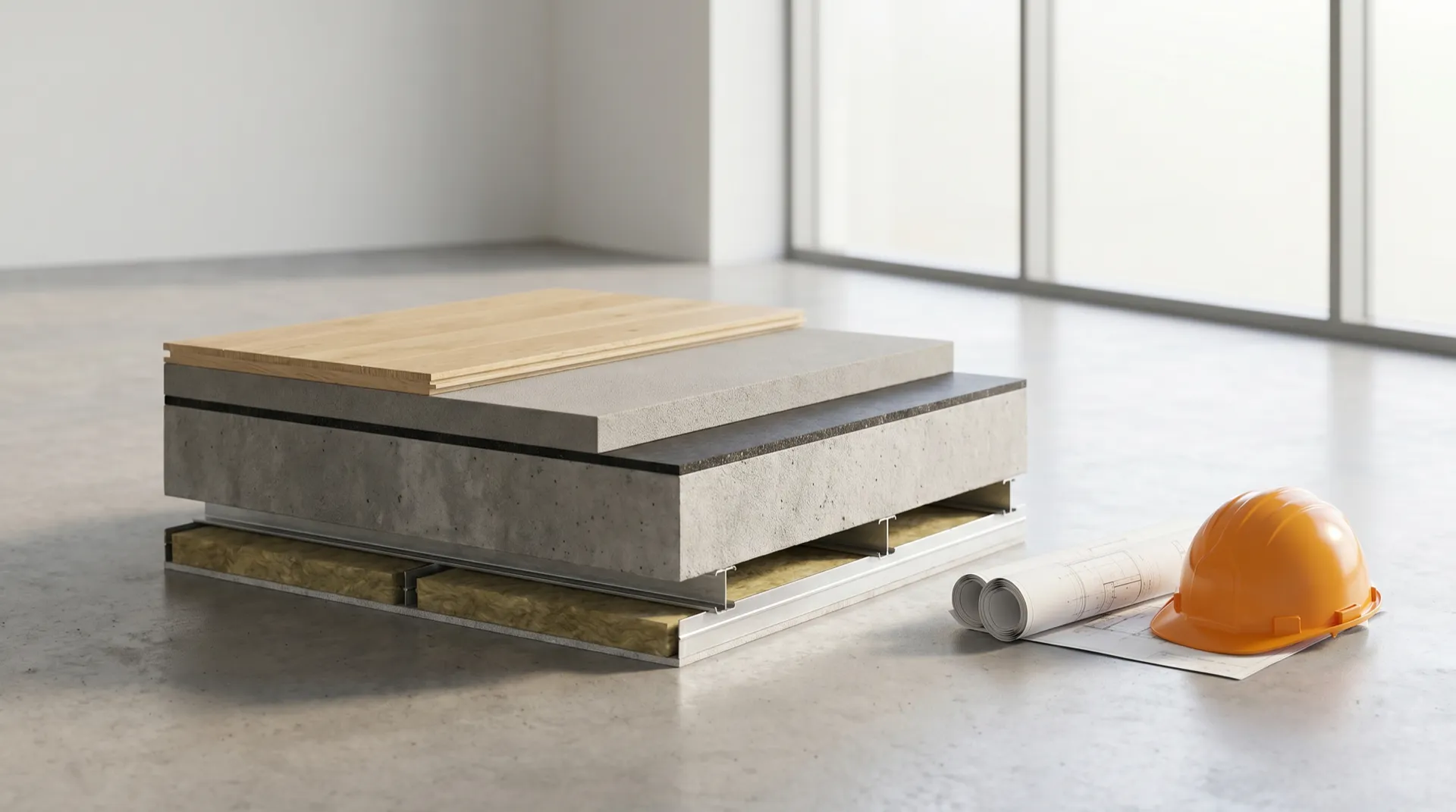
Separating (party) floors between flats face a tougher acoustic test than walls: they must control both airborne sound (voices, TV) and impact sound (footsteps), to the standards in Approved Document E. The floor build-up, the resilient layer and the ceiling below all have to work together.
We design and specify separating floor constructions for new flats, conversions and changes of use — concrete and timber alike — so they meet Part E’s airborne and impact requirements and pass pre-completion sound testing.
Airborne and impact, both handled.
Floor build-up design
Concrete and timber separating floor specifications, including screeds, resilient layers and floating finishes to control impact sound.
Ceiling & isolation
Independent and resiliently-mounted ceilings below to add airborne performance without short-circuiting the isolation.
Junctions & flanking
Perimeter detailing, skirting isolation and service penetrations — the details that decide whether impact sound passes.
When you need it
- You’re building or converting flats with separating floors that need to meet Part E.
- You need to control footfall (impact) noise between stacked dwellings.
- A separating floor failed its sound test and needs a remedial design.
One accredited team, start to finish.
Impact-sound specialists
Impact sound is where separating floors most often fail — we design specifically to control it.
Concrete or timber
Build-ups tailored to your structure and floor zone, balancing performance against depth and cost.
Design plus testing
The same team can sound-test the finished floors, so design and verification stay aligned.
Avoid expensive rework
A correct floor specification up front beats lifting finished floors to fix a failed impact test.
Party Floor Design — your questions
Why are separating floors harder than separating walls?
Floors must control both airborne sound and impact (footfall) sound, whereas walls are typically only assessed for airborne. Impact sound is transmitted directly into the structure, so the resilient layer, floating finish and ceiling all have to be designed together.
What is a floating floor and do I need one?
A floating floor is a walking surface isolated from the structural floor by a resilient layer, which reduces impact sound transmission. On many separating floors — especially timber — some form of resilient or floating treatment is needed to meet the Part E impact requirement.
Can you design a remedial fix for a failed floor?
Yes. We review the failed test, identify whether airborne, impact or flanking transmission is the problem, and design a remedial build-up or treatment to bring the floor up to standard, then re-test.
Do you provide the sound testing too?
Yes — we carry out pre-completion sound testing for both airborne and impact sound, so the same team can design and verify your separating floors.
Related services
Get a quote for party floor design.
Tell us about your project and we’ll come back with a fixed price and the earliest date we can attend.