
Ventilation
Testing
ATTMA accredited — from £45.
ATTMA-accredited Part F ventilation testing for new builds and conversions. MVHR, continuous MEV, intermittent extract and natural systems — all measured to UKAS-calibrated standards.
- ATTMA-accredited engineers
- UKAS-calibrated equipment
- Combined-test discounts available
£45
Vent Tests From
Same day
Certificate
Part F
Compliant
UKAS
Calibrated Kit
What is ventilation testing?
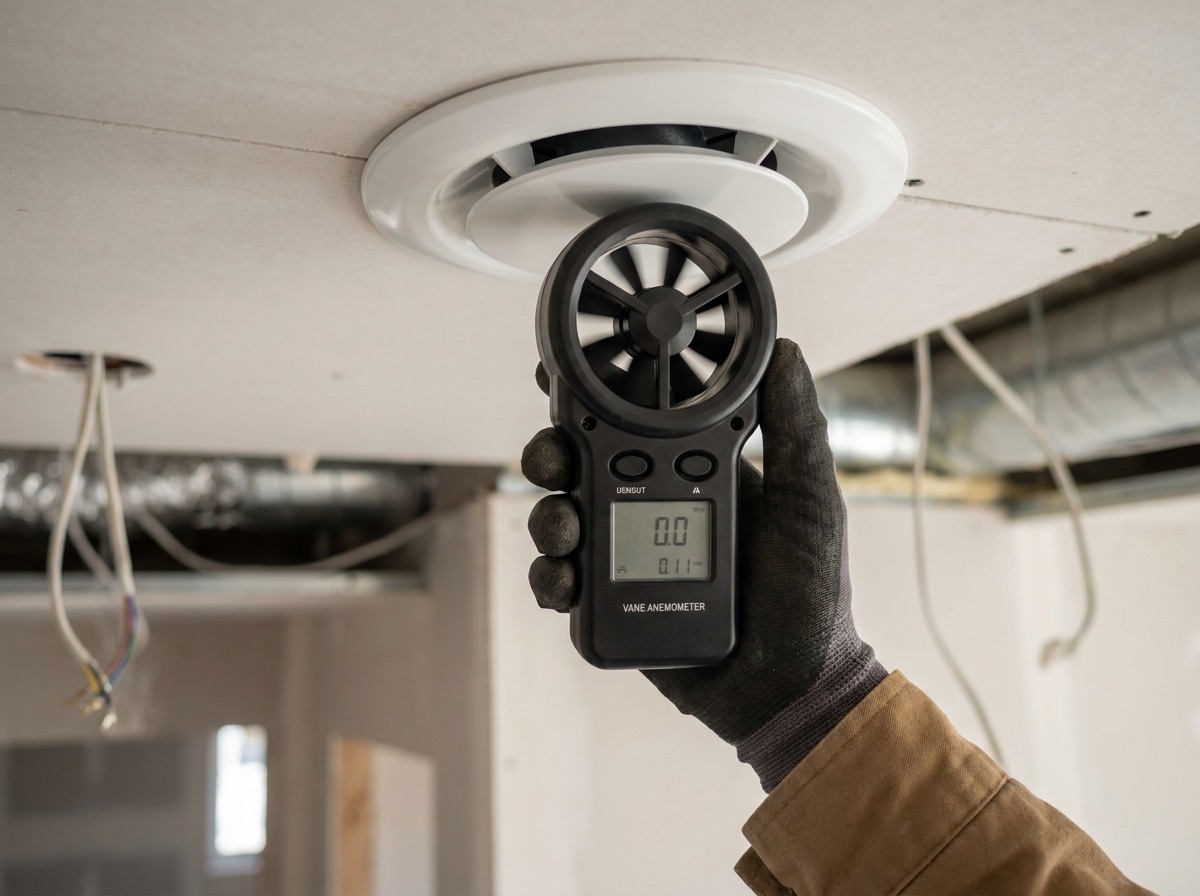
Ventilation testing measures the actual air flow rates at every supply and extract terminal in a dwelling to confirm the installed ventilation system is delivering what Part F of the Building Regulations requires. It is mandatory for all residential new builds and some conversions.
As buildings have become more airtight to meet Part L energy-efficiency targets, good ventilation has become critical. A well-sealed but poorly ventilated dwelling risks condensation, mould, and poor indoor air quality — with knock-on health impacts. Part F exists to keep the balance right.
What does the test cover?
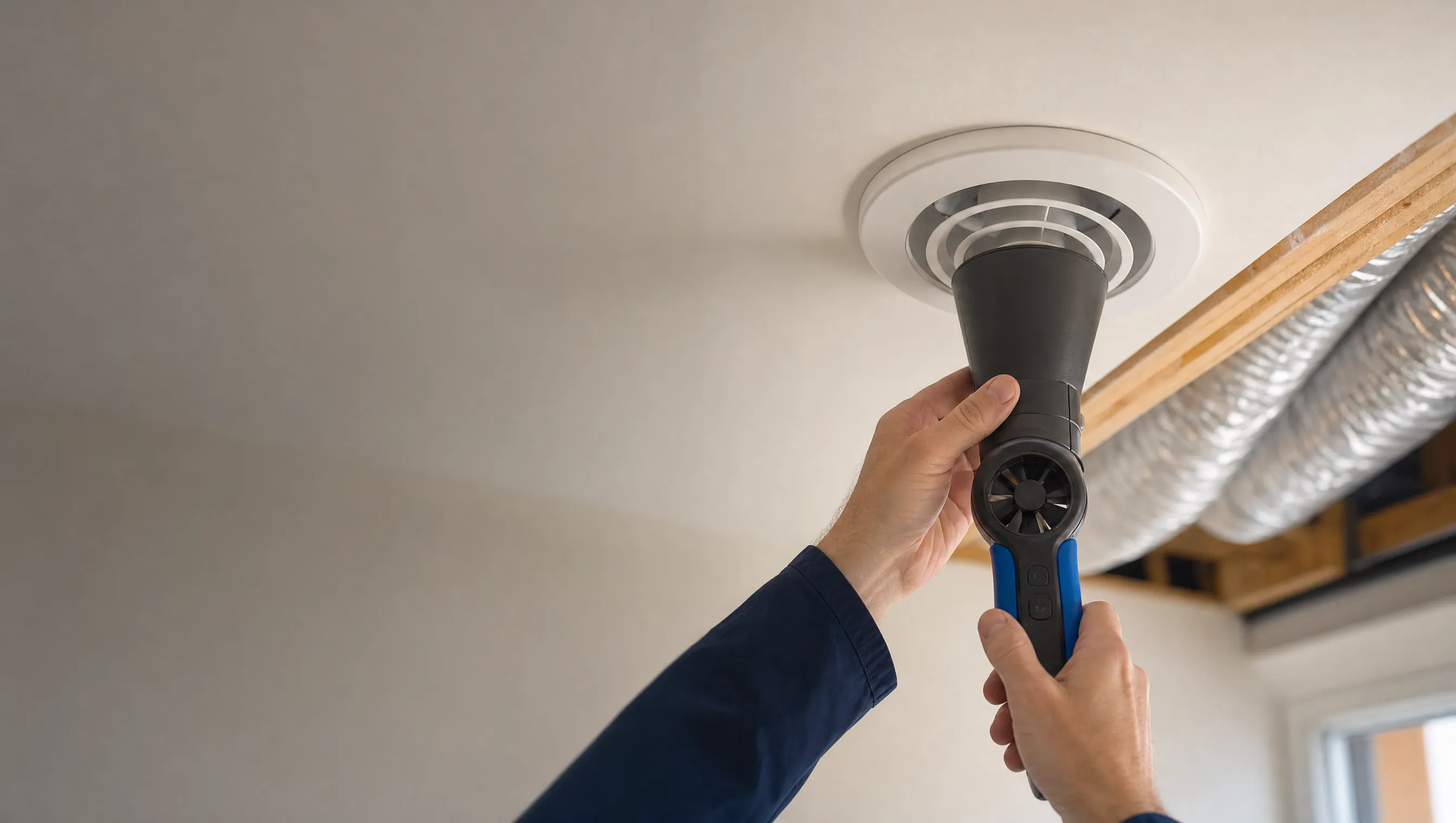
We measure every terminal in the dwelling — kitchen and bathroom extract, MVHR supply points, trickle vents — against the design flow rates specified in the ventilation strategy. For MVHR we check supply/extract balance. For continuous MEV we check extract at each terminal. For intermittent systems we check boost flow rates.
Why book it alongside air testing?
The two tests run at the same stage of the build — once the envelope is sealed and services are commissioned. Booking together saves a site visit, compresses your handover programme, and qualifies for a combined-test discount.
Testing every ventilation strategy.
MVHR, continuous MEV, intermittent extract, natural — whatever strategy your SAP specifies, we test it to the correct Part F standard.
MVHR Systems
Mechanical Ventilation with Heat Recovery — common in highly airtight new builds and Passivhaus projects. We test every supply and extract terminal and check the supply/extract balance to Part F tolerance.
- Every terminal measured
- Supply/extract balance checked
- Passivhaus-ready documentation
Continuous MEV
Mechanical Extract Ventilation running continuously from wet rooms. We measure extract rate at each terminal and compare against the whole-dwelling continuous supply rate required by Part F.
- Kitchen, bathroom, utility extract measured
- Boost mode verified
Intermittent Extract
Kitchen and bathroom extract fans that run on demand. We verify the rated flow at each fan and confirm trickle ventilation provision is correct for the dwelling size.
- Each fan's rated flow measured
- Trickle vent provision verified
Purge & Natural
Openable window area and passive stack ventilation strategies. We check opening areas against Part F and confirm your design matches what is actually installed on site.
- Openable area verified
- Passive stack vents checked
Sign off Part F in one visit.
ATTMA-accredited engineers, UKAS-calibrated equipment, and combined-test discounts when you book alongside your air test or sound test.
Clear value up front
Advice, diagnostics and combined-test discounts included. No hidden or extra fees at handover.
ATTMA Accredited
Every UKBC ventilation engineer holds ATTMA ventilation testing accreditation. Part F compliant testing recognised by all UK Building Control bodies.
UKAS Calibrated Equipment
All testing is carried out with UKAS-calibrated anemometers and flow hoods, re-calibrated annually. Your Building Control body will never query the accuracy.
Combined-Test Discounts
Book ventilation testing alongside your air test or sound test and we bundle the fee. One visit, one engineer, all the tests Part F and Part L need.
Part F Compliant Certification
Full ventilation test certificate covering every terminal, whole-dwelling supply rate and design-versus-actual flow comparison — ready for Building Control handover.
Same-Week Availability
If a cancellation opens up, we'll call to fit you in sooner. Working to a deadline? Tell us — we prioritise your project.
One Provider, Nationwide
MVHR, continuous MEV, intermittent extract, natural ventilation — one team, one point of contact, covering every UK region.
Common reasons vent tests fail.
After thousands of Part F tests, the same six issues cause most failures. The sooner these are addressed on site, the cleaner the test runs.
Commissioning not completed
The most common cause of failures — the MVHR unit or extract fan has power but has never been commissioned to the design flow rates. The commissioning engineer needs to do this before we attend.
Ducting crushed or kinked
Flexible ducting bent tighter than its minimum radius, or semi-rigid ducting crushed during board installation, reduces flow below Part F minimums. We identify which run is the problem.
Wrong fan speed set
MVHR units have multiple speed settings for normal, boost and low-flow modes. Leaving the unit on low for the test, or not boosting to kitchen levels, causes extract failures.
MVHR not balanced
Supply and extract flows significantly out of balance pressurise or depressurise the dwelling. The unit is commissioned but not balanced to within the 10% tolerance Part F expects.
Filters blocked at handover
New MVHR units shipped with protective shipping filters that were never swapped for the normal filters. Or filters that fit but never had the construction debris cleaned off them.
Extract grilles painted over
The classic decorator special — bathroom or kitchen extract grilles painted over during final decoration, blocking the terminal almost completely. Easy spot, often caught on site.
Three steps to your Part F certificate.
From first call to certificate in your inbox. Predictable, fast, and cheaper when bundled with air testing.
Send Us Your Details
Share your ventilation design, SAP inputs and site location. We confirm your price, the readiness checklist, and book you alongside the air test if you want the combined-test discount.
We Test On Site
Our ATTMA engineer measures every terminal with UKAS-calibrated equipment, records flow rates against design, and checks MVHR supply/extract balance. Typically 30–60 minutes per dwelling.
Certificate Issued
You get your Part F compliance certificate with full terminal-by-terminal flow data for Building Control handover. If anything underperforms, we flag the cause and the fix on site.
Transparent guide pricing.
Send us your plot count and ventilation strategy for an exact fixed-price quote — with the combined-test discount if you are booking alongside an air or sound test.
Typical starting price per dwelling. Larger MVHR systems and multi-plot developments quoted individually. Discounts apply when combined with air tightness or sound testing.
- Every terminal measured and reported
- UKAS-calibrated equipment
- Part F compliant certificate
- Discount when bundled with air or sound test
*This is a guide price. Actual prices vary with plot count, system complexity and access. Contact us for an accurate quote.
Get your quote & earliest test date
Takes 60 seconds. No obligation. If a cancellation opens up, we'll call to fit you in sooner.
Ventilation testing questions.
Everything you need to know about Part F ventilation testing — when to book, what we measure, and how to avoid the classic commissioning traps.
Still Got a Question? Ask Us When do I need a ventilation test?
Part F of the Building Regulations requires ventilation testing for all residential new builds and some conversions. The test confirms that the installed ventilation system (MVHR, MEV, intermittent extract, or natural) is actually delivering the design air flow rates.
How much does ventilation testing cost?
Ventilation testing starts from £45 + VAT per dwelling. Discounts are available when booked alongside air tightness testing or sound testing — we often do all three in a single visit to save programme time.
When should I book my ventilation test?
Once all ventilation systems (MVHR, extract fans, trickle vents) are installed, commissioned and have power. Testing usually happens shortly before or alongside the final air tightness test, before plot handover.
What flow rates do I need to meet?
Part F sets minimum extract rates — typically 13 l/s for a kitchen (intermittent) or 8 l/s (continuous), 6 l/s for bathrooms, plus whole-dwelling air supply rates based on bedroom count. We measure each terminal and compare against the design.
What happens if the ventilation test fails?
We identify which terminal(s) are short and the most likely cause — commissioning not completed, ducting crushed, wrong fan speed, filter blocked, extract grille painted over. The fix is usually on-site the same day.
What equipment do you use?
UKAS-calibrated anemometers and flow hoods certified to the relevant standards. All equipment is re-calibrated annually. All UKBC engineers hold ATTMA ventilation testing accreditation.
How long does a ventilation test take?
For a typical new-build dwelling with MVHR or continuous extract, testing takes 30–60 minutes. Larger dwellings with multiple MVHR units take proportionally longer. We coordinate around your other trades.
Can I combine ventilation testing with air and sound tests?
Yes — this is the most cost-effective way to book. One engineer, one site visit, all three tests signed off together, and a combination-test discount on the fee. Tell us at quote stage and we will bundle the price.
Do I need a test for Passivhaus or PAS 2035 retrofit?
Yes — both schemes require ventilation testing as part of verifying the mechanical ventilation strategy. We carry out ventilation testing for Passivhaus-certified and PAS 2035-retrofitted dwellings regularly.
Do you cover all of the UK?
Yes — ventilation testing is delivered across England, Wales, Scotland and Northern Ireland from our UK-wide engineer network.