Residential Noise Surveys
Proving new homes will be quiet enough to live in. We assess noise affecting dwellings against BS 8233 and the ProPG and recommend the mitigation needed to pass planning.
A residential noise survey assesses the noise environment affecting new or existing dwellings and demonstrates that suitable internal and external amenity noise levels can be achieved. It’s the assessment planners require when homes are proposed in a location exposed to road, rail, commercial or industrial noise.
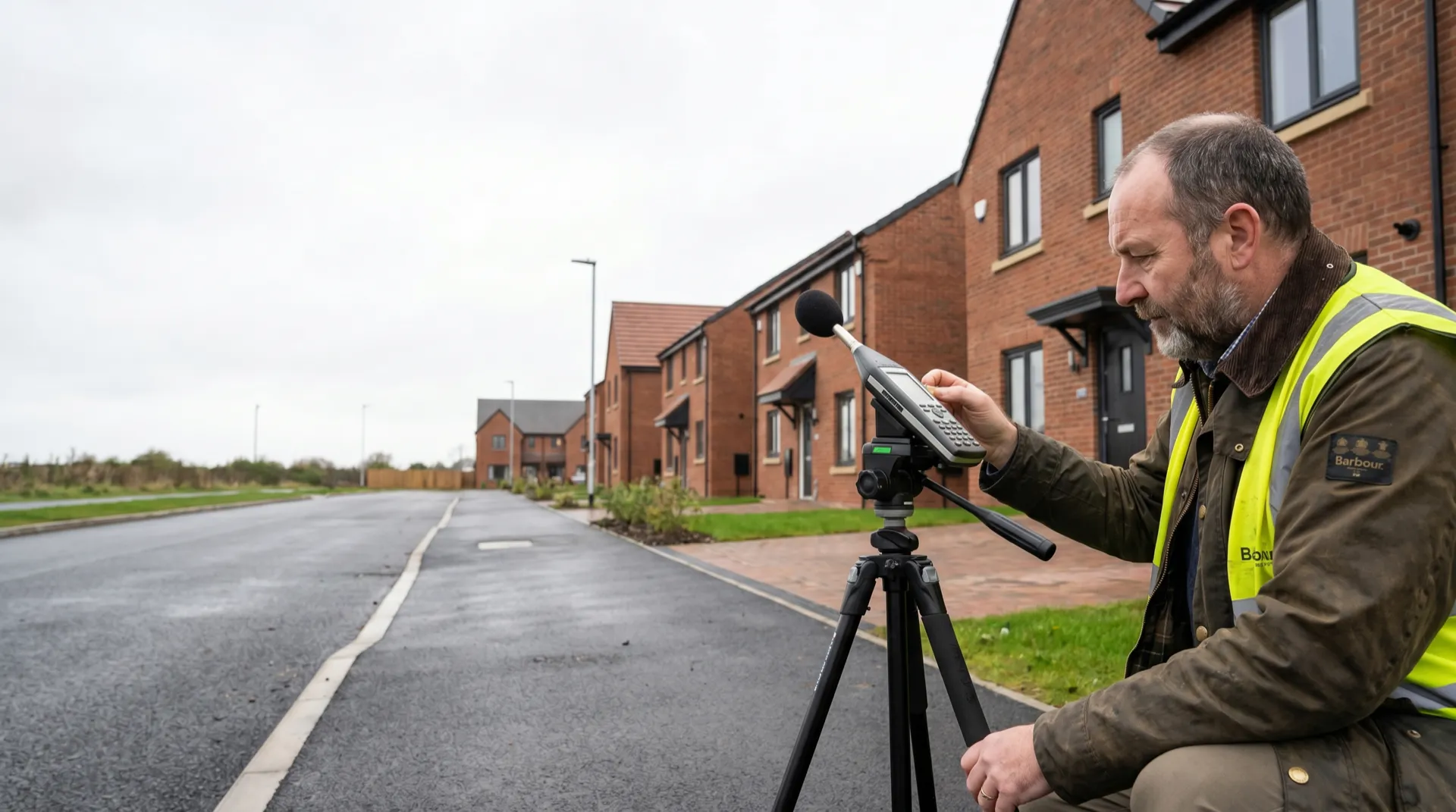
We measure the noise climate and assess it against BS 8233 — which sets recommended internal levels for living rooms and bedrooms and external levels for gardens and amenity space — together with the ProPG for new residential development.
From measurement to mitigation.
Noise climate measurement
Calibrated monitoring of the noise affecting the site across the relevant daytime and night-time periods.
BS 8233 assessment
Assessment of likely internal levels in habitable rooms and external levels in gardens and amenity areas against the recommended criteria.
Mitigation & glazing spec
Where needed, a clear specification — glazing performance, acoustic ventilation, screening or layout — to bring levels within target.
When you need one
- You’re proposing new dwellings on a site exposed to transport, commercial or industrial noise.
- A planning condition requires internal and amenity noise levels to be demonstrated.
- You need a glazing and ventilation specification that satisfies acoustic requirements.
One accredited team, start to finish.
Designed-in comfort
We help you achieve genuinely liveable internal levels, not just a number that passes on paper.
Buildable specifications
Glazing and ventilation specs that your contractor can actually source and install.
Joined-up with overheating
Noise mitigation often interacts with ventilation and overheating — we co-ordinate with our Part O work so the solutions don’t conflict.
Planning-ready
Reports structured to discharge conditions and satisfy environmental health officers.
Residential Noise Surveys — your questions
What internal noise levels do new homes need to meet?
BS 8233 gives recommended internal ambient noise levels — generally lower limits for bedrooms at night than for living rooms during the day — plus guideline levels for gardens and outdoor amenity space. Your survey assesses your scheme against these.
How does noise mitigation affect ventilation and overheating?
Closing windows to control noise can conflict with the need to ventilate and avoid overheating under Part O. We assess these together so the glazing, ventilation and overheating strategies work as a package rather than against each other.
Do existing homes ever need a noise survey?
Yes — for example, where a change of use, a new noise source nearby, or a planning requirement means existing dwellings’ noise exposure needs to be assessed and, if necessary, mitigated.
Will you specify the glazing for me?
Where mitigation is required, we provide the acoustic performance the glazing and ventilation need to achieve, so your design team and contractor can specify products that meet it.
Related services
Get a quote for residential noise surveys.
Tell us about your project and we’ll come back with a fixed price and the earliest date we can attend.