
Sound Insulation
Testing
SITMA registered — from £375.
Part E airborne and impact sound testing for new-build flats, conversions, HMOs, hotels and care homes. If a test fails we help diagnose the issues and specify solutions.
- SITMA-registered engineers
- Help diagnose the issues if failed
- Help specify solutions if failed
£375
Tests From
Same day
Certificate
Acoustic
Design Service
377+
Five-Star Reviews
What is sound insulation testing?
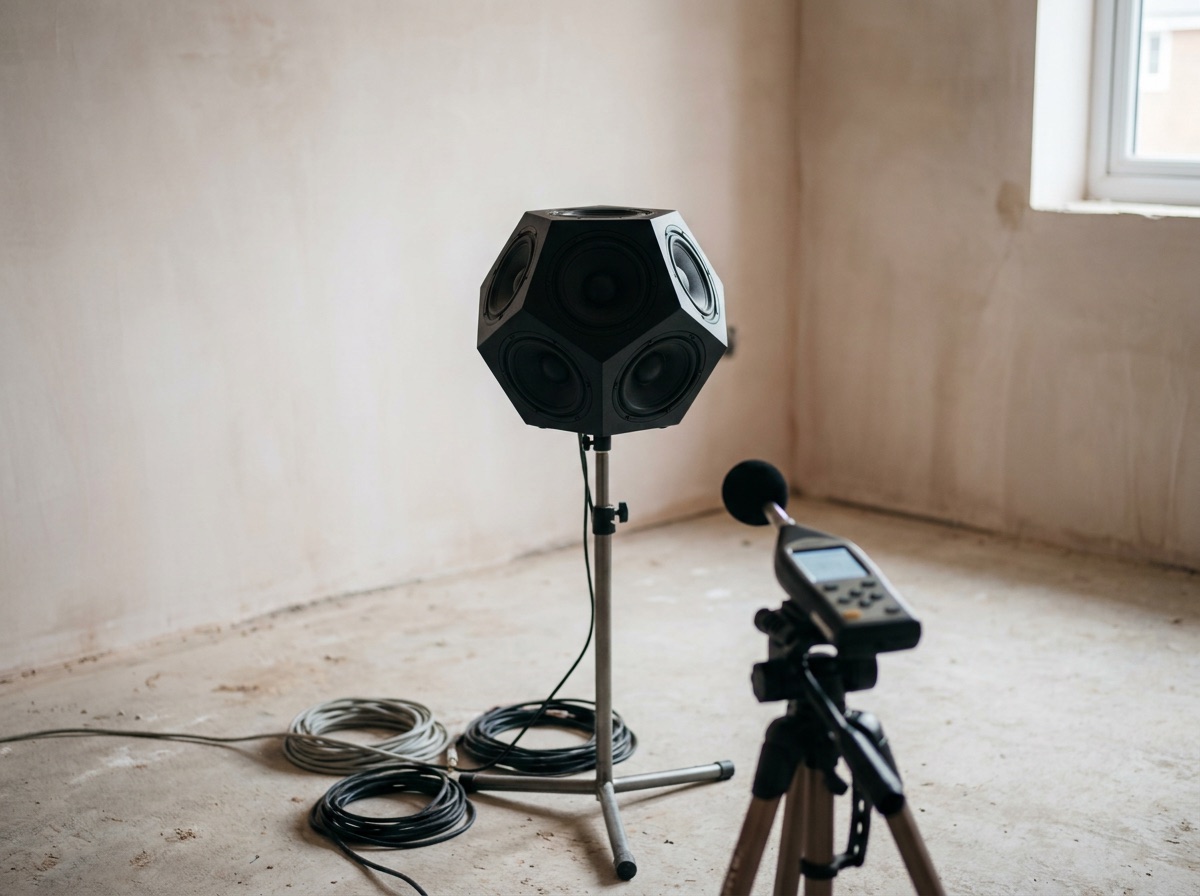
Sound insulation testing (sometimes called acoustic insulation testing) measures how effectively noise is prevented from travelling through the party walls and party floors between separate dwellings. Required under Part E of the Building Regulations, it is the test Building Control uses to sign off new flats, HMOs, hotels, care homes and conversions.
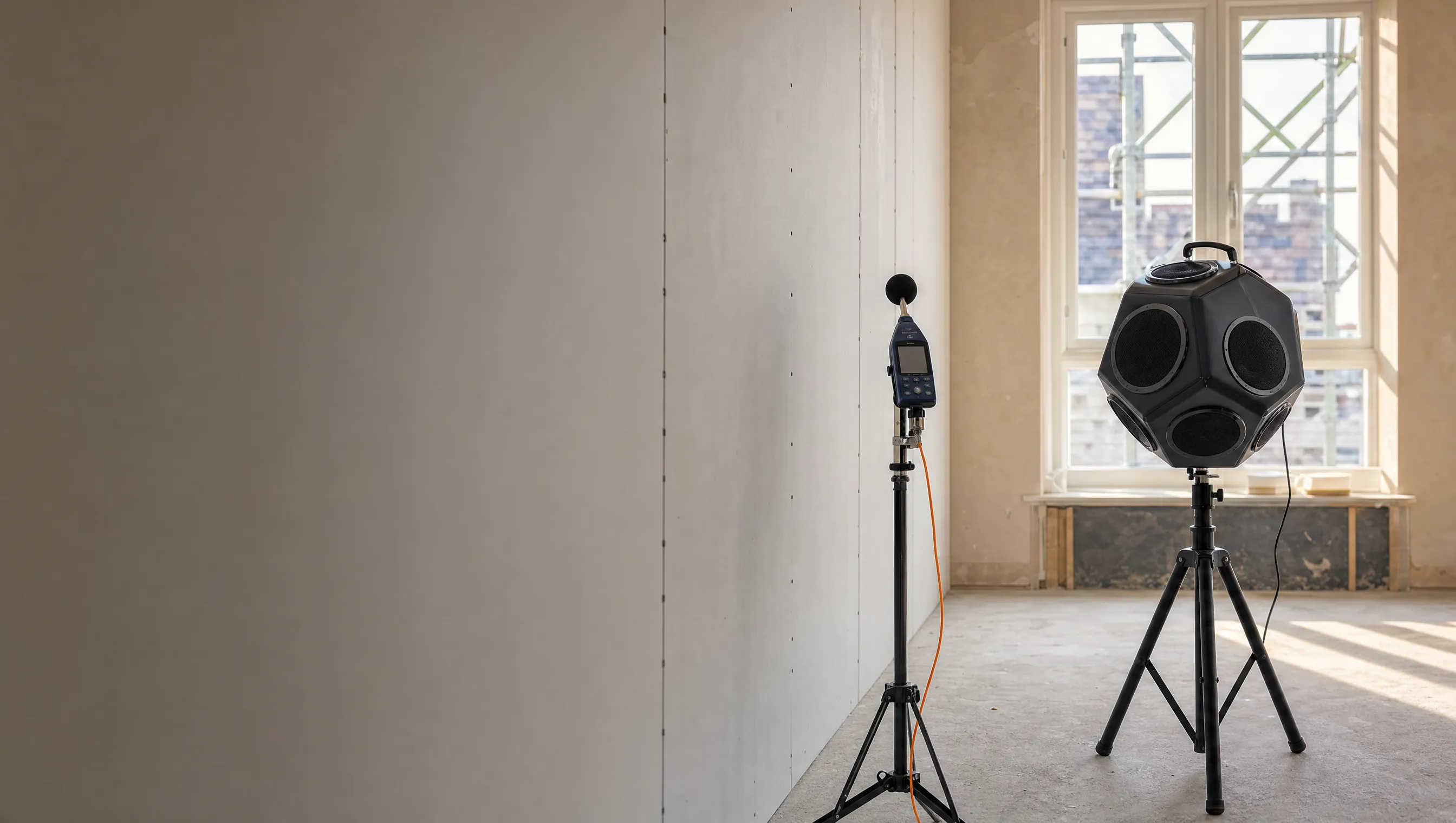
Testing is split into two parts. Airborne sound testing uses a loudspeaker and amplifier to generate sound in one room and measures how much reaches the next. Impact sound testing uses a calibrated tapping machine with five metal hammers on the floor above to mimic footsteps and measures what is heard below.
When do I need it?
New multi-dwelling developments (blocks of flats, semi-detached and terraced housing), conversions of houses or commercial buildings into flats, and large residential buildings such as hotels, HMOs and care homes all need Part E testing — unless you are building to pre-approved Robust Details.
What scores do I need to pass?
New build: airborne 45dB (minimum), impact 62dB (maximum). Change of use / conversion: airborne 43dB (minimum), impact 64dB (maximum). Schools are measured against BB93 and hospitals against HTM 08-01 — we cover both.
Sound testing for every project.
From new multi-dwelling developments to change-of-use conversions and large residential buildings.
New Multi-Dwelling Builds
Blocks of flats, semi-detached houses, terraced streets — anywhere Part E applies because separate dwellings share a party wall or party floor. We test to the correct sample size for your development.
- Airborne & impact tests to Part E
- Correct sample size advised
- From £375 + VAT per test set
Change-of-Use Conversions
House-to-flats conversions, pub-to-flats, commercial-to-residential. Part E applies at the lower change-of-use thresholds (43dB airborne / 64dB impact).
- Lower change-of-use thresholds applied
- Acoustic design advice on existing build-ups
Hotels, HMOs & Care Homes
Large residential buildings where people sleep in separate rooms or units. Part E applies and testing is often required at each floor level. Schools (BB93) and hospitals (HTM 08-01) have their own standards — we cover both.
- Hotels, HMOs, care & nursing homes
- BB93 schools and HTM 08-01 hospitals
No Robust Details
If your build-up is not covered by the pre-approved Robust Details scheme — or you are registered but want extra assurance — testing is required. Most non-standard conversions fall into this category.
- Non-standard & bespoke build-ups
- Acoustic design available pre-construction
Full support if a test fails.
SITMA-registered engineers, clear site readiness checklists, and real help diagnosing and specifying solutions if a test does not pass.
If a test fails, we help
Help diagnose the issues if failed and help specify solutions if failed — using our acoustic design service to model your build-up and recommend exactly what to change.
SITMA-Registered
All sound tests carried out by SITMA-registered engineers, to UKAS calibration standards and in line with current Part E methodology.
Help Diagnose the Issues If Failed
If a test fails and we know the build-up, we identify which element (party wall, party floor, junction, service route) is the weak point.
Help Specify Solutions If Failed
We recommend the specific changes to bring the element up to standard — additional layers, isolation details, resilient bars, floor treatments — matched to what's realistic on your site.
Clear Site Readiness Checklist
We send a readiness checklist before we attend so you know exactly when the rooms are ready — and avoid wasted callout fees.
Acoustic Design Service
If you want to de-risk upfront, our acoustic design service specifies compliant wall and floor build-ups before construction — common for hotels, care homes and non-standard conversions.
One Provider, Nationwide
Part E residential, BB93 schools, HTM 08-01 hospitals, mixed-use — one team, one point of contact, covering every UK region.
Common reasons sound tests fail.
After years of Part E testing, the same six issues cause most failures. The earlier we can flag them, the cheaper they are to fix.
Flanking transmission
Sound bypasses the party wall by travelling through adjoining floors, ceilings or external walls. One of the most common causes of airborne failures, and often missed during construction.
Service penetrations through party walls
Sockets, switches, ducts and pipes breaking the acoustic seal of a party wall. Gaps of even a few millimetres can drop performance several decibels.
Back-to-back electrical sockets
Sockets positioned directly opposite each other on either side of a party wall create a direct acoustic bridge. Offsetting them by at least 150mm is standard good practice.
Poorly sealed perimeter
Gaps where the party wall meets the external wall, ceiling or floor allow airborne sound to pass around the wall itself. Continuous acoustic sealant is required on all perimeters.
Timber joist deflection
Lightweight timber floors with inadequate mass or no resilient layer will frequently fail the impact standard. Our acoustic design service identifies this before the floor is built.
Ceiling/floor junction detail
The detail where a party floor meets the external wall is often where both airborne and impact failures originate. Getting the wall continuous across the floor zone is critical.
Three steps to your Part E sign-off.
From first call to certificate in your inbox. Simple, predictable, and with real help if a test fails.
Send Us Your Details
Share your plans, party wall and floor build-ups, and the site location. We quote the correct sample size for Part E, confirm your price and send the site readiness checklist.
We Test On Site
Our SITMA-registered engineer runs airborne tests with loudspeaker and amplifier, and impact tests with the tapping machine. A typical pair of units takes 2–3 hours on site.
Certificate & Diagnosis
You get your full Part E test report for Building Control. If anything fails, we help diagnose the issues and specify the fix — and re-test once the remedial work is done.
Transparent guide pricing.
Send us your plans and build-ups for an exact fixed-price quote including the correct Part E sample size for your development.
Typical starting price per set of tests. Three options — full acoustic test (airborne + impact), airborne only, or impact only. Volume discounts available for multi-unit developments.
- Full acoustic insulation test — £375
- Airborne-only sound test — £375
- Impact-only sound test — £375
- Part E compliant certificate for Building Control
*This is a guide price. Actual prices vary with project size, number of tests and access. Contact us for an accurate quote.
Get your quote & earliest test date
Takes 60 seconds. No obligation. If a cancellation opens up, we'll call to fit you in sooner.
Sound testing questions.
Everything you need to know about Part E sound insulation testing — what it involves, what you need to score, and what happens if you fail.
Still Got a Question? Ask Us How many sound tests do I need?
This depends on the number of units and the layout of the building — Part E sets the sample requirement. Our team will always quote you to the correct sample size. For most developments this means a combination of airborne and impact tests across party walls and floors between separate dwellings.
What do I need to score to achieve a pass?
Part E minimum standards: New Build — airborne 45dB (minimum) and impact 62dB (maximum). Change of use / conversion — airborne 43dB (minimum) and impact 64dB (maximum). Different standards apply to schools (BB93) and hospitals (HTM 08-01).
What happens if the test fails?
If we know the build-up of the wall or floor, we help diagnose the issues if failed and help specify solutions if failed. Our acoustic design service can model the current build-up and recommend exactly what to change to bring it up to standard.
At what stage does the building need to be tested?
The party floor or wall construction must be complete, but testing should take place before cosmetic floor coverings are fitted. Doors and windows to each tested room should also be installed. Our site readiness checklist has full detail.
What is an airborne sound test?
We use a loudspeaker and amplifier to generate sound at multiple frequencies in one room, then measure the sound level in the adjoining room. The difference tells us how much noise travels through the party wall or floor. It simulates talking, music and TV.
What is an impact sound test?
A tapping machine with five metal hammers strikes the party floor to mimic footsteps. We measure the resulting noise in the room below. Impact testing is only relevant to floors between dwellings, not walls.
Are "Robust Details" an alternative to testing?
Yes. Robust Details are pre-approved construction systems that are deemed to meet Part E without testing. If you are registered with the Robust Details scheme and build to the spec exactly, sound testing can sometimes be avoided. Most developers still test a small sample to confirm installation quality.
Do hotels, student accommodation and care homes need testing?
Yes — the Part E minimum standards apply to residential buildings where people sleep in separate rooms/units. That includes hotels, nursing homes, care homes, student accommodation and hostels.
How long does testing take?
A typical set of airborne and impact tests on a pair of units takes about 2–3 hours on site. Larger developments are scheduled across a day. We coordinate with your site manager to minimise disruption to other trades.
Do you provide sound testing near me?
Yes — we provide nationwide sound insulation testing across England, Wales, Scotland and Northern Ireland, with engineers based across the UK.