
SBEM
Calculations
Elmhurst registered — from £250.
Part L compliant SBEM Calculations for commercial new builds, extensions and conversions. BRUKL report and EPC included. Unlimited specification revisions.
- Elmhurst-registered assessors
- BRUKL report & EPC included
- Unlimited specification revisions
£250
SBEMs From
3–10 Days
Typical Turnaround
L2A + L2B
Full Coverage
0
Hidden Fees
What is an SBEM calculation?
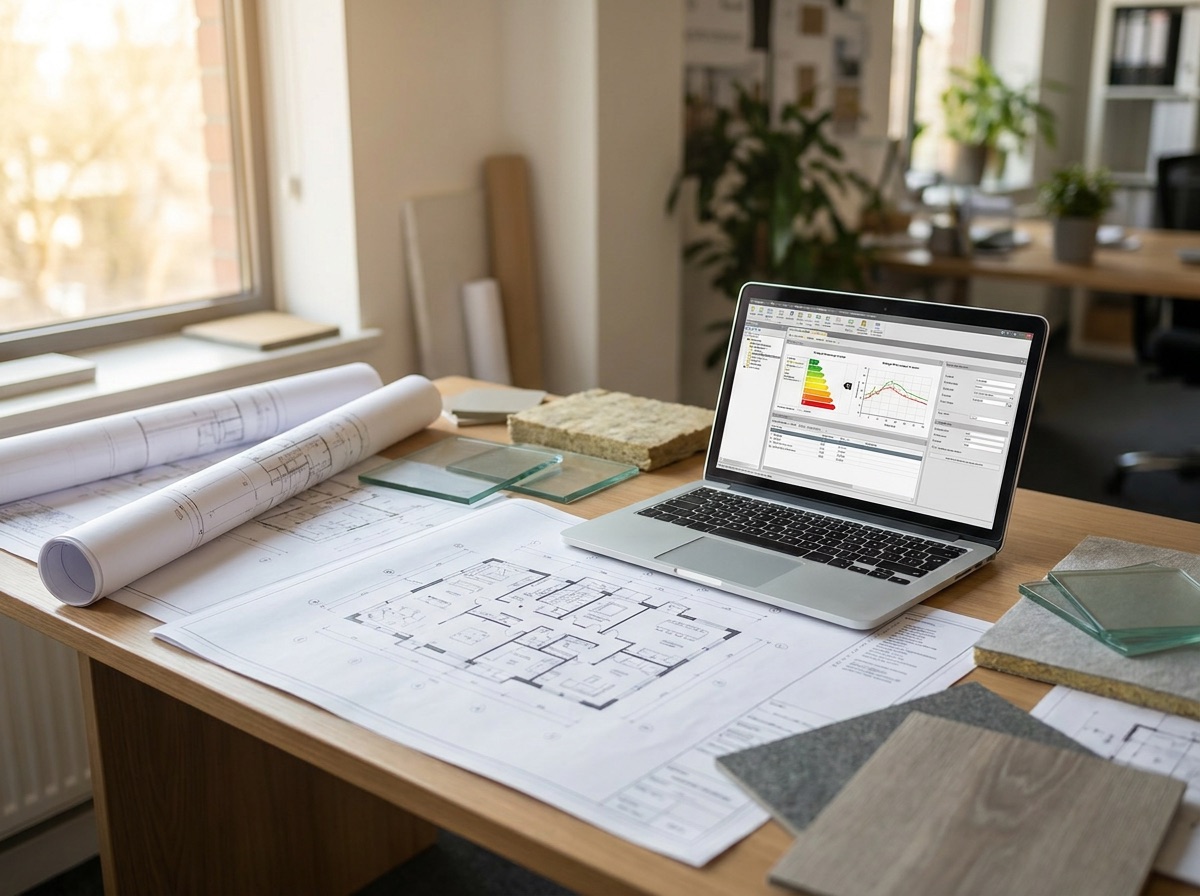
SBEM (Simplified Building Energy Model) is the commercial equivalent of SAP. It measures the predicted energy performance of non-domestic buildings — offices, retail, schools, healthcare, warehouses, industrial, mixed-use — and demonstrates whether the design meets Part L of the Building Regulations.
SBEM is based on the National Calculation Methodology (NCM) and has been part of UK Building Regulations since 2006. It produces the Target Emissions Rate (TER) and Building Emissions Rate (BER) for your building, alongside the BRUKL report required by Building Control and the non-domestic EPC.
When do I need an SBEM?
You need an SBEM for every new-build non-domestic property (L2A), and for most extensions or conversions over 100m² or 25% of the existing building (L2B). The rules apply across England and Wales under Part L, Scotland under Section 6, and Northern Ireland under Part F1.
Why instruct early?
Swap a lighting specification, glazing g-value or cooling plant at design stage and it costs nothing. Swap it at tender and it costs thousands. Swap it on site and it costs weeks of programme. Engaging us pre-planning is the cheapest way to pass Part L.
SBEMs for every commercial project.
From single retail units to multi-storey offices, from L2B extensions to full change-of-use conversions.
L2A New Builds
Full SBEM Calculations for new-build offices, retail, schools, healthcare facilities, warehouses and industrial units. BRUKL report for Building Control and the non-domestic EPC at completion.
- All non-domestic building types
- BRUKL report + non-domestic EPC
- From £250 + VAT for smaller units
L2B Extensions
SBEM Calculations for commercial extensions over 100m² or more than 25% of the existing building. We model both the existing building and the extension to confirm the whole building complies.
- Existing + extension assessed together
- Free check on whether you need an SBEM
L2B Conversions
Warehouse-to-office, retail-to-leisure, industrial-to-studio and other change-of-use projects. We assess the converted space against the non-domestic Part L targets and recommend cost-effective upgrades.
- Change-of-use specialists
- Cost-balanced upgrade recommendations
All UK Regions
We run SBEMs under Part L (England & Wales), Section 6 (Scotland) and Part F1 (Northern Ireland) with the correct regional climate data and fuel assumptions for each jurisdiction.
- England, Wales, Scotland, Northern Ireland
- Regional climate data applied correctly
Pass Part L commercial without the rework.
Elmhurst-registered assessors, unlimited specification revisions, and one fixed price covering TER/BER, BRUKL and the non-domestic EPC.
Clear value up front
Advice, unlimited revisions, BRUKL and EPC all included in the quoted price. No hidden or extra fees at handover.
Elmhurst Registered
SBEMs produced by assessors registered with Elmhurst Energy. Certified for Part L non-domestic compliance across England, Wales, Scotland and Northern Ireland.
Simple Email-Based Workflow
Share drawings, HVAC schedules, lighting design and specifications by email — no app to set up. We keep your design team, contractor and our assessors aligned throughout.
Unlimited Specification Revisions
Change the HVAC strategy, glazing, lighting controls or add renewables as many times as you need. Every quote is inclusive — no fee per revision.
Design-Stage Advice Included
If the first run does not pass, we recommend the cheapest route to compliance before specification is locked — better g-value, LED controls, or a modest renewables uplift.
BRUKL Report + EPC Included
One fixed price covers the TER/BER calculation, BRUKL report for Building Control, and the non-domestic EPC at completion. No extra charges at handover.
L2A + L2B, Nationwide
New builds (L2A), extensions and conversions (L2B), from single-unit retail to multi-storey offices. One team, one point of contact, covering every UK region.
Common reasons commercial SBEMs don't pass.
After years of commercial SBEMs, the same six issues cause most design-stage failures. Here are the ones we check before we even open the modelling software.
Lighting power density too high
Classic SBEM failure — lighting specified before LED controls are confirmed. We recommend fitting strategies that pass with standard equipment rather than forcing expensive luminaires.
Cooling plant oversized
Heat-gain calculations that over-spec cooling plant penalise the SBEM. We cross-check mechanical engineer outputs and flag cooling strategies that will fail at design stage.
HVAC controls missing
Modern Part L requires demand-controlled ventilation, variable-speed drives, and weather compensation on most commercial systems. Missing these often fails an SBEM that would otherwise pass.
Glazing g-value wrong
Glazing specified for aesthetics without checking solar gain g-values penalises the SBEM through summer overheating and cooling load. We flag this before the order is placed.
Service zones not modelled
Different activity zones (office, retail, warehouse, plant room) have different SBEM profiles. Modelling the whole building as a single zone inflates the BER.
Late design changes breaking BER
Glazing swapped, cooling plant upgraded, or insulation downgraded on site without updating the SBEM. As-Built BER then fails. Share changes with us early and we update the model.
Three steps from plans to BRUKL.
From first call to final EPC. Simple, predictable, and inclusive of revisions along the way.
Send Us Your Plans
Share architectural drawings, fabric specification, HVAC strategy, lighting design and any renewables by email. We confirm your price and timeline within 24 business hours.
Design Stage SBEM
We run the Design Stage SBEM, flag compliance gaps, and recommend the cheapest route to pass — revising the model as many times as you need at no extra charge.
BRUKL + EPC
Once the building is complete and the air test has been carried out, we run the As-Built SBEM, issue the BRUKL report for Building Control and the non-domestic EPC for handover.
Transparent guide pricing.
Send us your drawings and spec for an exact fixed-price quote. One price covers the lot — TER/BER, BRUKL, EPC and unlimited revisions in between.
Starting price for smaller non-domestic units. Offices, retail, warehouses, schools and complex mixed-use buildings are quoted individually based on floor area and complexity.
- TER and BER calculations
- BRUKL report for Building Control
- Non-domestic EPC certificate
- Unlimited specification revisions
*This is a guide price. Actual prices vary with project size, complexity and number of zones. Contact us for an accurate quote.
Get your SBEM quote & start date
Takes 60 seconds. No obligation. Working to a deadline? Tell us — we'll prioritise your project.
SBEM questions.
Everything you need to know about commercial SBEM Calculations — what they cover, what they cost, and how to avoid rework on Part L non-domestic compliance.
Still Got a Question? Ask Us What is an SBEM Calculation?
SBEM (Simplified Building Energy Model) is the commercial equivalent of SAP. It is required to demonstrate Part L compliance for new non-domestic buildings, extensions and conversions across England and Wales, with parallel routes in Scotland (Section 6) and Northern Ireland (Part F1).
How much does an SBEM Calculation cost?
SBEM Calculations start from £250 + VAT for small non-domestic units. Offices, retail, warehouses, schools and larger projects are priced individually by floor area and complexity. Send us your drawings for an exact fixed-price quote — with the BRUKL report and EPC included.
What is the difference between SAP and SBEM?
SAP is used for dwellings; SBEM is used for everything else — offices, retail, schools, healthcare, warehouses, industrial units and mixed-use buildings where the non-domestic element is assessed separately. If you have a mixed-use building, we often run both.
What is included with an SBEM?
Every SBEM quote includes: Target Emissions Rate (TER) and Building Emissions Rate (BER) calculations, the BRUKL report required by Building Control, the non-domestic EPC at completion, and unlimited specification revisions for your project team.
When should I book my SBEM?
As early as possible at design stage. The earlier we model it, the cheaper the route to compliance — swapping a glazing specification or lighting control strategy at design costs nothing; swapping it on site costs thousands. We recommend engaging us before planning submission.
Do I need an SBEM for an extension?
Usually yes — commercial extensions over 100m² or more than 25% of the existing building typically require an L2B SBEM under Part L2A. Smaller extensions may be compliant under a simpler Elemental route. Send us your drawings and we will confirm which route applies.
How long does an SBEM take?
Small SBEMs turn around in 3–5 working days. Large or complex commercial projects can take up to 10 working days. If you have a Building Control deadline, tell us — we will prioritise your project.
What documents do I need to provide?
Architectural drawings (plans, sections, elevations), fabric U-values, glazing specification (including g-value), HVAC strategy, lighting design (lumens per watt, controls), ventilation strategy, and any renewables. The more complete the specification, the fewer revisions.
What happens if the building doesn't pass?
We identify the cheapest route to compliance — typically better glazing, reduced lighting power density, tighter HVAC controls, or adding a small amount of renewables. We revise the model as many times as you need at no extra charge until the building passes.
Do you cover Scotland and Northern Ireland?
Yes — SBEM under Section 6 (Scotland) and Part F1 (Northern Ireland) is delivered to the same fixed-price, same-turnaround standard as England and Wales. Regional climate data and fuel assumptions are applied correctly for each region.