
MVHR
Commissioning
Airflow testing — quoted per project.
An MVHR system only performs as designed when it is correctly commissioned. We measure, balance and certify your system to Part F of the Building Regulations — giving building control the evidence they need to sign your project off.
- Calibrated instruments, on-site balancing
- Part F commissioning notice included
- Pairs with air & ventilation testing
Part F
Compliant
Every Terminal
Measured & Balanced
Same Week
Availability
Nationwide
UK Coverage
What is MVHR commissioning?
MVHR commissioning is the process of measuring, adjusting and documenting the airflow rates of a Mechanical Ventilation with Heat Recovery system. An installed system that has never been commissioned may be running at the wrong speed, with unbalanced valves, or with restricted ductwork — delivering poor air quality and wasting energy without any visible sign that something is wrong.
Part F of the Building Regulations requires a commissioning notice to be provided to building control confirming the system achieves its design airflow rates. Without this notice, building control cannot sign the project off. Our commissioning visit covers everything in a single call: pre-commissioning check, airflow measurement at every terminal, balancing, and the completed commissioning paperwork.
Why healthy airflow matters
A correctly balanced MVHR system extracts moisture and pollutants from wet rooms while supplying fresh, pre-warmed air to habitable rooms — preventing condensation, mould and the indoor air quality problems that affect occupant health. Modern airtight buildings rely almost entirely on mechanical ventilation to maintain this balance. If the system is not properly set up, occupants are breathing stale air in a well-sealed box.
The link to energy performance
Your SAP calculation models a specific ventilation strategy and assumed airflow rates. Commissioning produces the measured evidence that the installed system actually delivers those rates — protecting the modelled energy performance and your EPC rating.
Every stage of the commissioning visit.
From pre-commissioning check through to the signed commissioning notice — what happens on site, in the right order.
Pre-Commissioning Check
Confirm the system is fully installed, all ductwork is connected, the unit is running, and no obvious installation issues are present before measurement begins. Catching problems at this stage avoids wasted time.
- Unit running and ductwork complete
- Filters and terminals accessible
Airflow Measurement
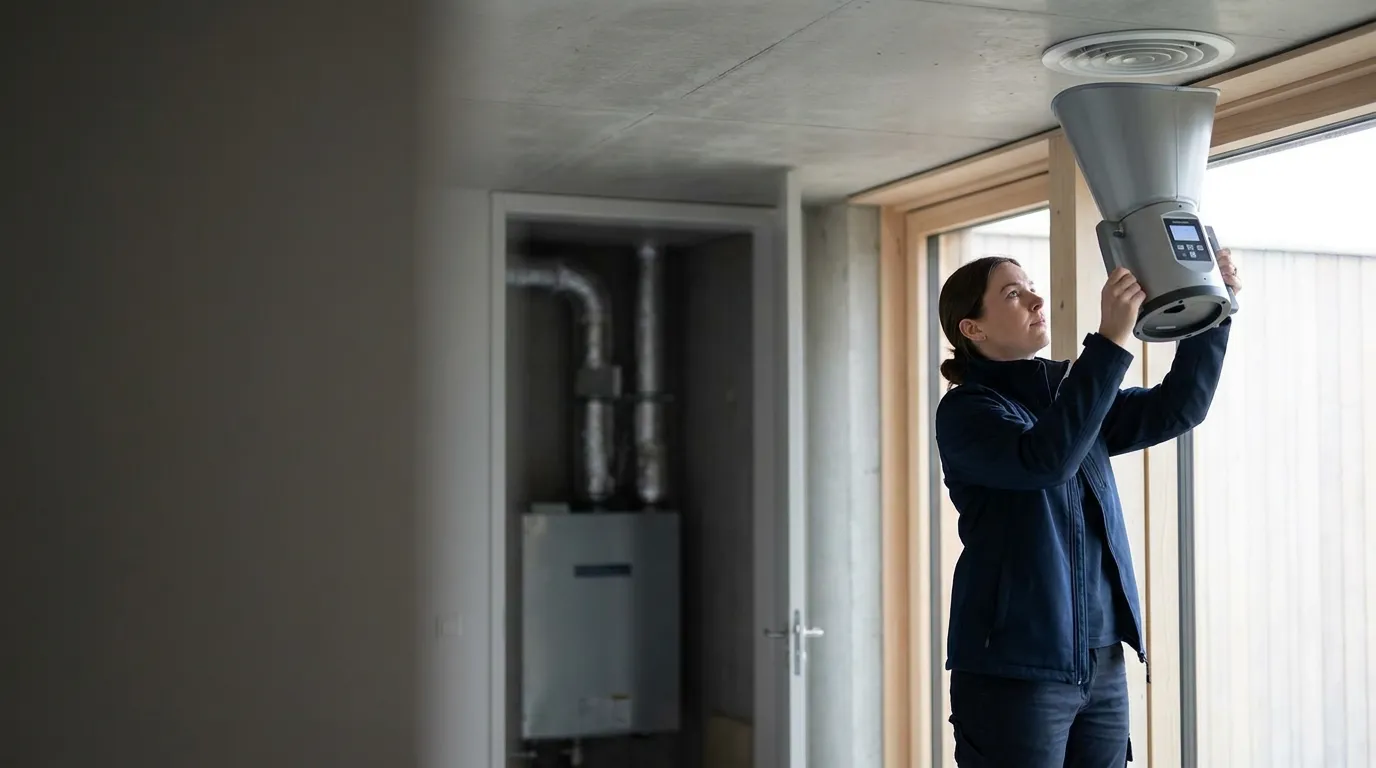
Using calibrated instruments, supply and extract flow rates are measured at every terminal. Results are compared against the design rates from the ventilation strategy to identify where balancing is needed.
- Every supply & extract terminal measured
- Calibrated instruments used throughout
Balancing
Valves and unit settings are adjusted on site until each room meets its designed flow rate. Supply and extract are balanced across the whole system to within acceptable tolerances before the visit ends.
- Valves adjusted room by room
- Supply/extract balance confirmed
Commissioning Notice
A completed commissioning sheet recording measured flow rates against design values at every terminal. This is the document building control need to see before they can sign off the project under Part F.
- Measured vs. design rates recorded
- Accepted by all UK building control bodies
One visit, Part F signed off.
Calibrated instruments, on-site balancing, commissioning notice — and the option to combine with ventilation testing and air pressure testing in a single visit.
All Part F & Part L evidence in one visit
Book MVHR commissioning alongside your air pressure test and ventilation test — one engineer, one site visit, all the sign-off paperwork you need.
Calibrated Equipment
Airflow measurements taken with calibrated instruments. Your building control officer will have no reason to query the accuracy of the commissioning data.
Part F Compliant Paperwork
A completed commissioning notice recording measured flow rates against design values at every terminal — the exact document building control need for sign-off.
On-Site Balancing
We do not just measure and report — we adjust valves and unit settings on site until every room meets its designed rate before the certificate is issued.
Pairs With Ventilation & Air Testing
Combine MVHR commissioning with ventilation testing and air pressure testing in a single visit. One engineer, all the Part F and Part L evidence you need, fewer disruptions on site.
Same-Week Availability
Working to a handover deadline? Tell us — we prioritise your project and aim to visit within the same week for most locations across the UK.
One Provider, Nationwide
New-build homes, apartments, conversions and multi-plot developments — one point of contact covering every UK region with clear upfront pricing.
What delays MVHR commissioning.
Most commissioning delays come from the same handful of installation issues. Knowing them in advance means they can be caught before the engineer arrives.
System not fully commissioned before attendance
The MVHR unit has power but the installer has not set the flow rates to design. Pre-commissioning by the installer is a prerequisite — we check this at quote stage so there are no wasted visits.
Blocked or unswapped filters
New units are sometimes shipped with protective packaging filters that were never replaced with the correct operating filters, or construction dust has loaded the filters before commissioning.
Flexible ductwork kinked or crushed
Flexible ducting routed through tight ceiling voids or bent below its minimum radius significantly reduces airflow to individual terminals, causing them to fall short of their design rate.
Valves not adjusted after installation
Supply and extract valves left fully open from installation deliver unbalanced flow — some rooms get too much, others too little. Balancing these is the core of commissioning.
Unit speed set incorrectly
MVHR units have multiple fan speed settings. Leaving the unit on the lowest speed or boost mode during commissioning produces readings that do not reflect normal operation.
Terminals obscured or painted over
Supply or extract grilles that have been painted over, or ceiling terminals partly blocked by insulation, restrict airflow and prevent accurate measurement.
Three steps to your commissioning notice.
From first call to the completed commissioning paperwork in building control’s hands. Simple, fast, and clear pricing upfront.
Send Us Your Details
Share the site location, MVHR system type, number of terminals, and your target completion date. We confirm the price and let you know exactly what needs to be ready before the visit.
We Commission On Site
Our engineer carries out the pre-commissioning check, measures airflow at every terminal with calibrated instruments, balances the system, and adjusts settings until each room meets its design rate.
Notice Issued
You receive the completed commissioning notice recording measured versus design flow rates at every terminal. This document is ready for building control and satisfies the Part F documentation requirement.
Quoted per project.
MVHR commissioning is priced per project based on the number of terminals, system complexity and location. Send us the details and we will turn around a fixed price.
Quoted per project. Price depends on number of terminals, system type and location. Discounts available when combined with ventilation testing or air pressure testing in a single visit.
- Calibrated instruments — every terminal measured
- On-site balancing included
- Part F commissioning notice for building control
- Can be combined with air & ventilation testing
Prices vary with project size, system complexity and travel. Contact us for an accurate fixed quote.
Get your MVHR commissioning quote
Takes 60 seconds. No obligation. Working to a handover deadline? Tell us — we’ll prioritise your project.
MVHR commissioning questions.
Everything you need to know about MVHR commissioning — when to book, what the visit involves, and how it fits with your Part F and Part L obligations.
Still Got a Question? Ask Us What is MVHR commissioning?
MVHR commissioning is the process of measuring and adjusting a Mechanical Ventilation with Heat Recovery system so that every room achieves the airflow rate it was designed for. The engineer uses calibrated instruments to measure supply and extract at each terminal, balances the system, and produces a commissioning notice for building control.
Is MVHR commissioning a legal requirement?
Yes. Part F of the Building Regulations requires that mechanical ventilation systems are commissioned and that a commissioning notice is provided to building control before sign-off. Without this documentation, the building control officer cannot complete the final inspection.
When should MVHR commissioning be carried out?
Commissioning should take place once the MVHR unit and all ductwork are fully installed, the system has power, and the building is reasonably complete — typically towards the end of the project and shortly before the final air pressure test.
Can you commission a system that someone else installed?
Yes — we commission MVHR systems regardless of who the original installer was. You simply need the system to be fully installed and running before we attend.
How does MVHR commissioning relate to SAP calculations?
Your SAP calculation models a specific ventilation strategy and assumed airflow rates. Commissioning provides the measured evidence that the installed system actually delivers those rates. If the system is under- or over-performing, it can affect your SAP result and your energy performance certificate.
Can I book MVHR commissioning alongside an air pressure test?
Yes — and we recommend it. MVHR commissioning and air pressure testing are both needed before building control sign-off and typically happen at the same stage of the build. Booking together means one site visit, saving programme time and often reducing the overall fee.
What does the commissioning certificate include?
The commissioning notice records the measured supply and extract flow rates at every terminal compared to the design rates, the unit settings, and confirmation that the system has been balanced. This is the document building control need to see.
What happens if the system does not meet its design flow rates?
We identify which terminals are short and advise on the most likely cause — blocked filters, crushed ducting, incorrect unit settings, or unbalanced valves. Most issues can be resolved on site before the commissioning certificate is issued.
Do you cover the whole of the UK?
Yes — MVHR commissioning is available across England, Wales, Scotland and Northern Ireland. Most visits are booked within the same week. Tell us your postcode and we will confirm availability at quote stage.