Road & Rail Noise Surveys
Building near a road or railway? We measure and assess transportation noise and specify the mitigation needed to make homes liveable and satisfy planning.
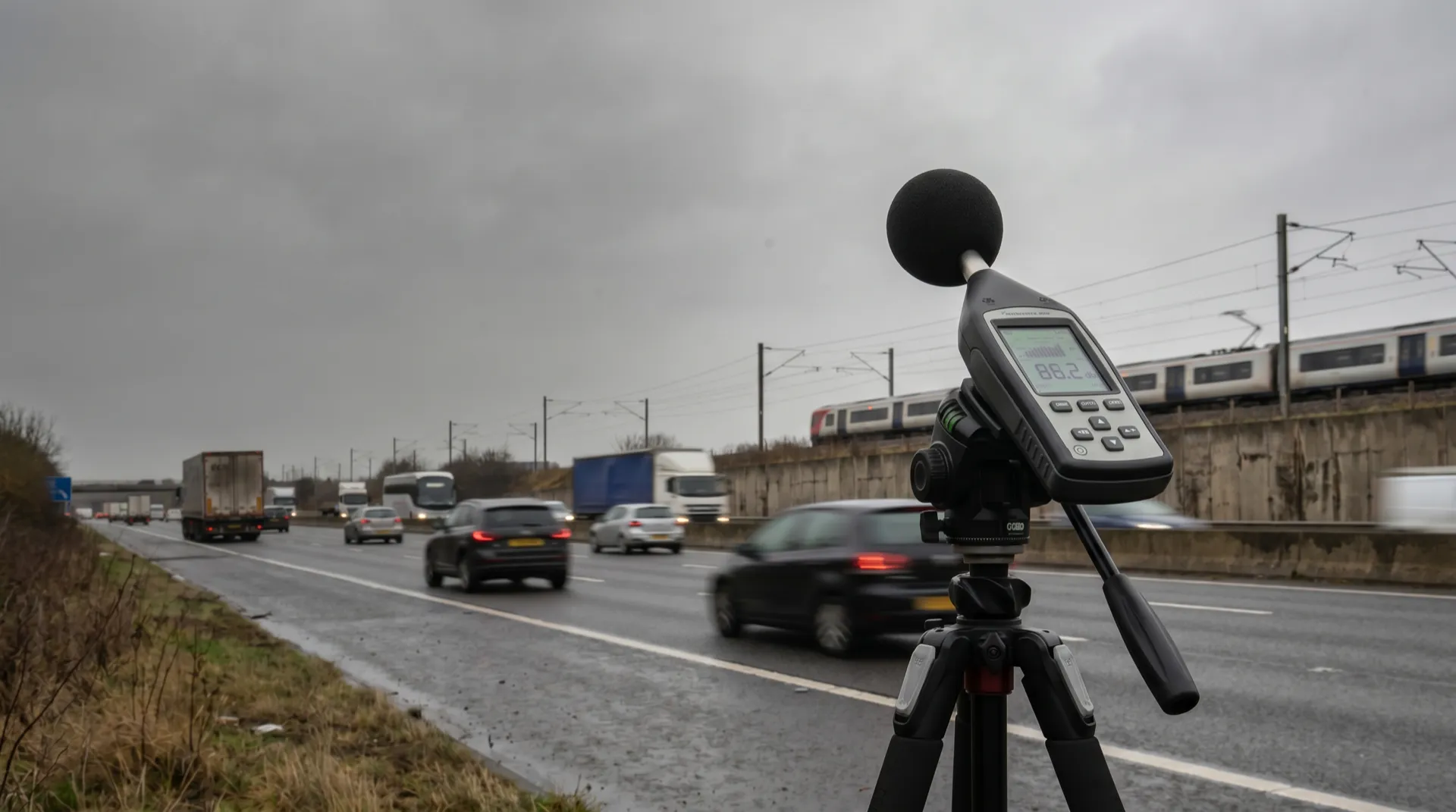
A road and rail noise survey assesses transportation noise affecting a development — traffic on nearby roads and trains on adjacent lines — and demonstrates that suitable internal and amenity noise levels can be achieved. Transportation noise is one of the most common reasons a residential planning application attracts a noise condition.
We measure the noise climate and assess it against BS 8233 and the ProPG, accounting for the distinct character of road and rail noise, and specify the glazing, ventilation and layout measures needed to bring levels within target.
Traffic and rail noise, properly assessed.
Transportation noise measurement
Calibrated monitoring of road and/or rail noise across daytime and night-time periods, capturing peak pass-by events as well as ambient levels.
BS 8233 / ProPG assessment
Assessment of internal and amenity levels for the proposed dwellings, accounting for the character of transport noise including night-time train events.
Mitigation specification
Glazing performance, acoustic ventilation, barriers and layout measures to achieve compliant levels, with the improvement quantified.
When you need one
- You’re proposing homes near a busy road, motorway or railway line.
- A planning condition requires transportation noise to be assessed and mitigated.
- You need to demonstrate acceptable bedroom levels against night-time traffic or train pass-bys.
One accredited team, start to finish.
Transport-specific expertise
We account for the very different character of steady traffic noise and intermittent rail events.
Workable mitigation
Glazing, ventilation and barrier specs designed to be sourced and built, not just to pass on paper.
Co-ordinated with ventilation
We balance noise mitigation with Part O overheating and Part F ventilation so the strategies don’t conflict.
Planning-ready reporting
Reports written to discharge transport-noise conditions and satisfy environmental health officers.
Road & Rail Noise Surveys — your questions
How is rail noise different from road noise?
Road traffic tends to produce a relatively steady noise level, while railways produce intermittent, higher-level pass-by events — particularly significant at night. Our assessment treats them differently and considers maximum noise levels from individual train movements, not just averages.
Do you measure or model the noise?
We usually measure the existing noise climate on site, and can also model future scenarios — for example, predicted changes in traffic flow — where the assessment requires it.
What mitigation is typical near roads and railways?
Common measures include enhanced acoustic glazing, acoustic trickle vents or mechanical ventilation so windows can stay closed, acoustic barriers or fencing, and careful layout — placing bedrooms and gardens away from the noise source.
Will this satisfy the ProPG?
Yes — for new residential development near transport noise we follow the Professional Practice Guidance (ProPG) alongside BS 8233, which is the approach planning authorities expect.
Get a quote for road & rail noise surveys.
Tell us about your project and we’ll come back with a fixed price and the earliest date we can attend.