What is air tightness testing?
Air tightness testing (also called air pressure testing or air permeability testing) measures how much uncontrolled air leaks through the building envelope at a reference pressure of 50 Pa.
The result is expressed in m³/h.m² @ 50 Pa — the volume of air per hour, per square metre of envelope area, at 50 pascals of pressure differential.
The lower the number, the tighter the building.
When is testing required?
- All new build dwellings under Part L1A (England & Wales), Section 6 (Scotland), Part F1 (Northern Ireland).
- All new build non-dwellings of any size under Part L2A.
- Certain extensions and material changes of use where the design SAP/SBEM specifies a tested air permeability.
For new build dwellings, the as-built tested figure must equal or better the design figure entered in your SAP calculation.
Typical air permeability targets
| Build type | Typical design target |
|---|---|
| Standard volume new build dwelling | 5.0 m³/h.m² @ 50 Pa |
| Higher-spec new build (heat pump) | 3.0 m³/h.m² @ 50 Pa |
| Passivhaus | 0.6 ach @ 50 Pa |
The 2021 Part L update tightened the regulatory cap and made tighter targets the norm rather than the exception. Most well-detailed new builds comfortably hit 3–4 m³/h.m² with the right specification.
How the test works
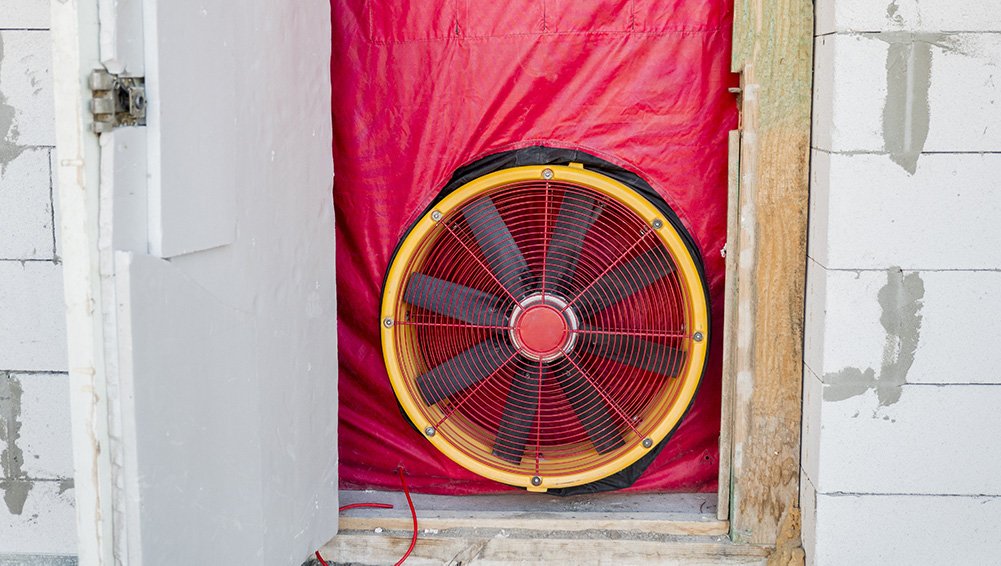
A calibrated blower-door fan is fitted into a doorway. The fan pressurises (and depressurises) the building to a series of reference pressures. Air flow is measured at each pressure, and the result is plotted to give the air permeability figure at 50 Pa.
A typical single-dwelling test takes 1–2 hours on site. We email the certificate the same day on a pass.