
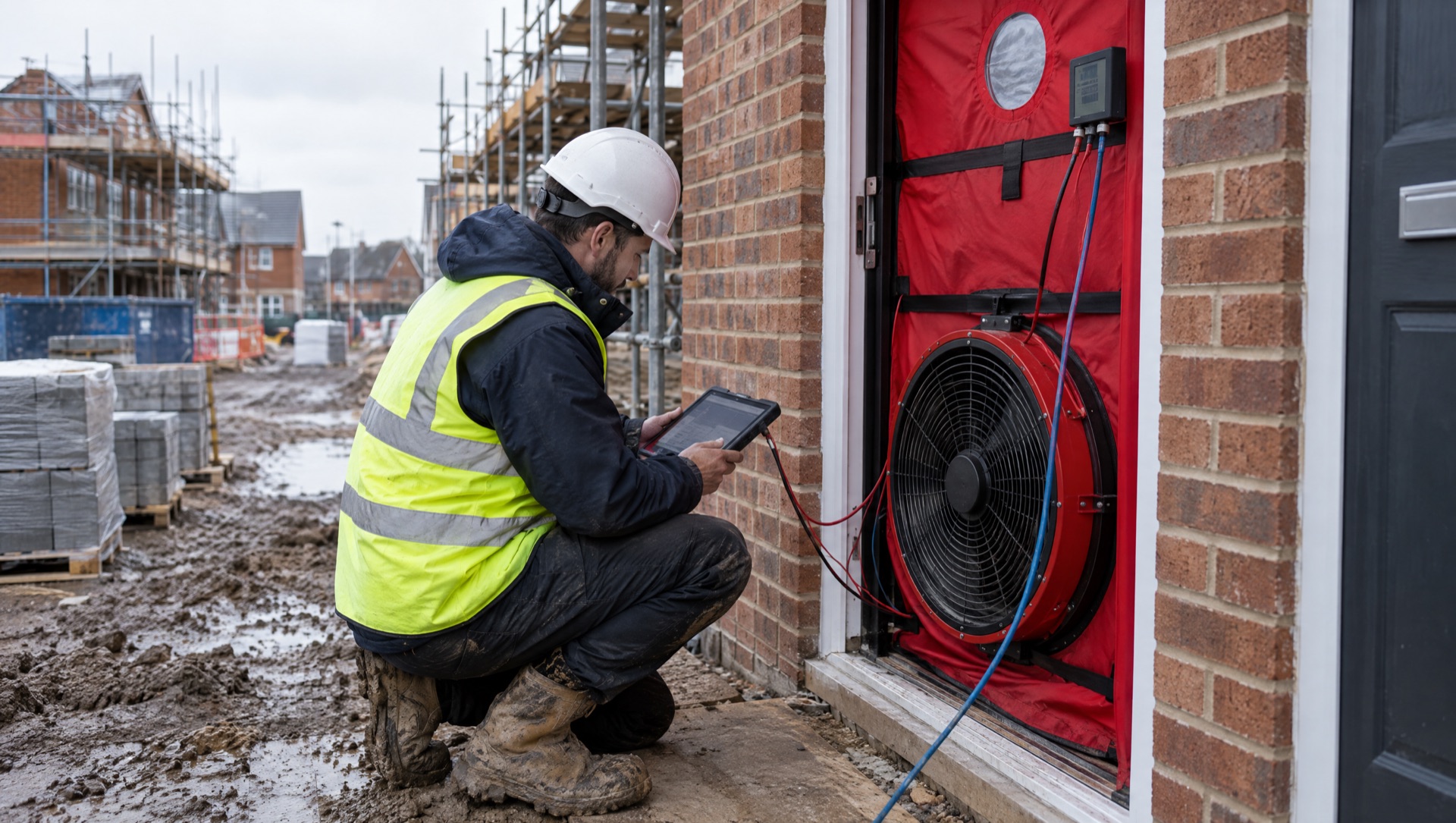
When you’re managing tight margins on a development, saving a few quid on building compliance looks like an easy win. You open Google, find the cheapest provider offering air tightness testing, and book them in.
But here is a stat to think about: about 1 in 5 of our clients come to us after doing exactly that.
How much does a cheap air tightness test really cost?
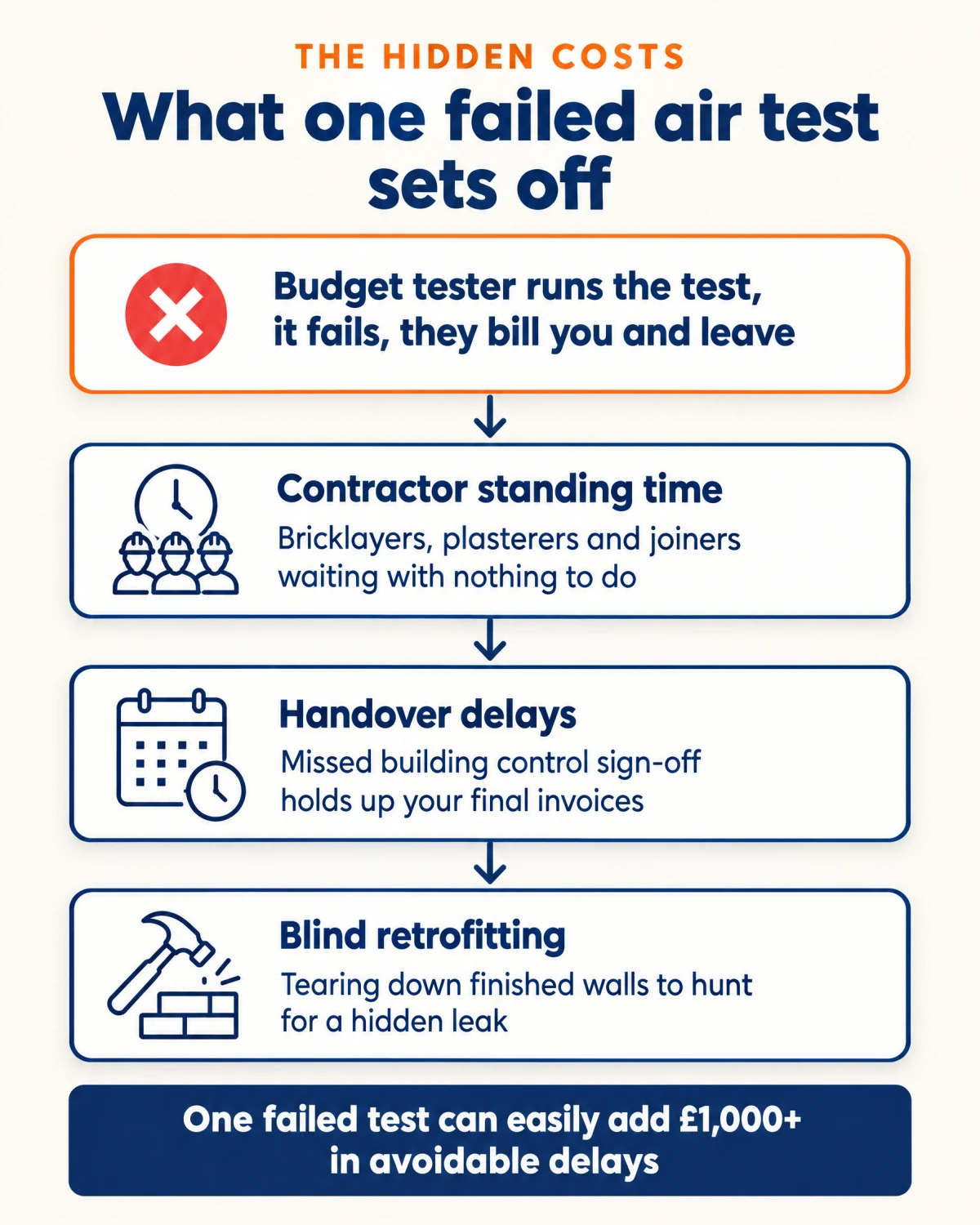
The price you are quoted is not the price you pay. A UKBC domestic air test starts from £95 + VAT per dwelling, and a budget quote might shave a little off that. The real cost is decided on test day. If the building fails and the tester simply leaves, the knock-on costs of standing time, a missed sign-off and blind remedial work can easily add £1,000+ in unnecessary project delays, many times the few pounds saved at booking.
That is why comparing air tightness test costs on the headline price alone is a false economy. The question to ask is not “how cheap is the test?” but “what happens if it fails?”
What happens when an air tightness test fails?
Rock-bottom budget testers rarely prep you. They roll up to your site, run the test, watch it fail, hand you a bill, and drive away to their next appointment. This instantly triggers a chain reaction of hidden expenses:
- Contractor standing time: bricklayers, plasterers and joiners stuck waiting around with nothing to do.
- Handover delays: missing your building control sign-off date, which delays your final invoice payments.
- Blind retrofitting: tearing down expensive finishes to find a hidden leak that could have been spotted weeks ago.
There is a less obvious cost too. Under Approved Document L, the measured air permeability feeds your as-built SAP calculation. The legal maximum for a new dwelling is 8.0 m³/(h·m²) at 50 Pa, but your real target is the design figure in your SAP, which is usually far lower. A result worse than design can put your whole energy compliance at risk, even when it is technically under 8.0. See what air test score you need for a new build.
What should an air tightness test include?
Compliance shouldn’t be a trap. When you work with an ATTMA-accredited team, you aren’t just buying a pass/fail certificate. You’re buying an insurance policy for your timeline.
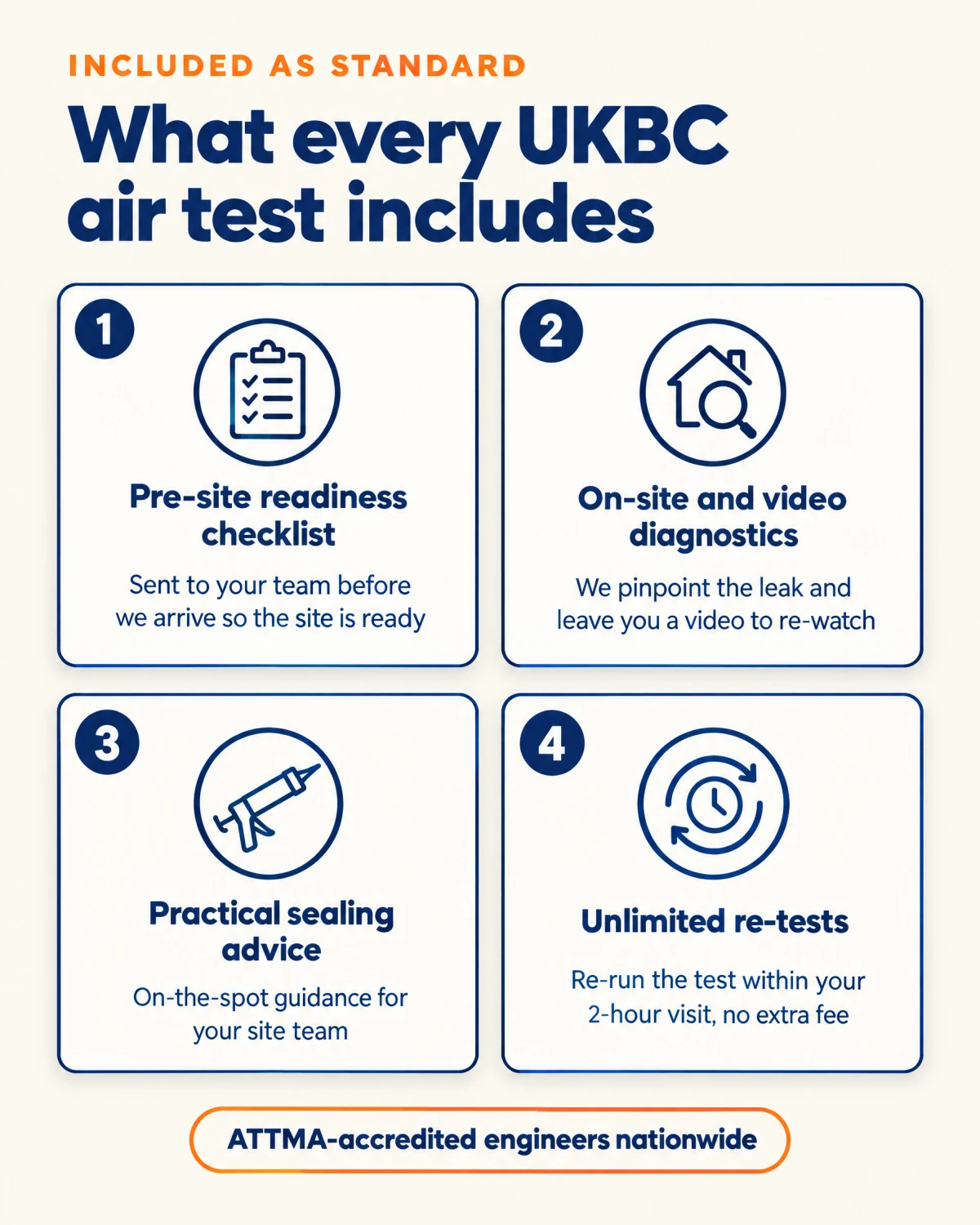
Every UKBC test includes:
- Pre-site readiness checklists: sent to your team before we arrive, so your site is fully prepared for test day.
- On-site diagnostics and post-test video diagnostics: if the building fails, we don’t pack up. We diagnose to pinpoint the exact leakage location, leaving you with a video to re-watch.
- Practical sealing advice: our engineers give your team immediate, on-the-spot guidance. Often, a 5-minute fix turns a fail into a same-day pass.
- Unlimited re-tests within your 2-hour visit: giving your team time to apply quick fixes and have the test re-run during the same visit for no extra fee.
Five questions to ask any air tester before you book
- Are you ATTMA or iATS registered? Building control expects a registered tester working to the ATTMA technical standard.
- What happens if the building fails? Do they diagnose the leaks, or record the result and leave?
- Are re-tests included? Find out whether a re-test is a new booking and a new fee.
- Will you tell us how to prepare? A readiness checklist before the visit avoids the most common, easily fixed fails.
- Do you know our design target? A good tester checks your SAP design air permeability, not just the 8.0 legal limit.
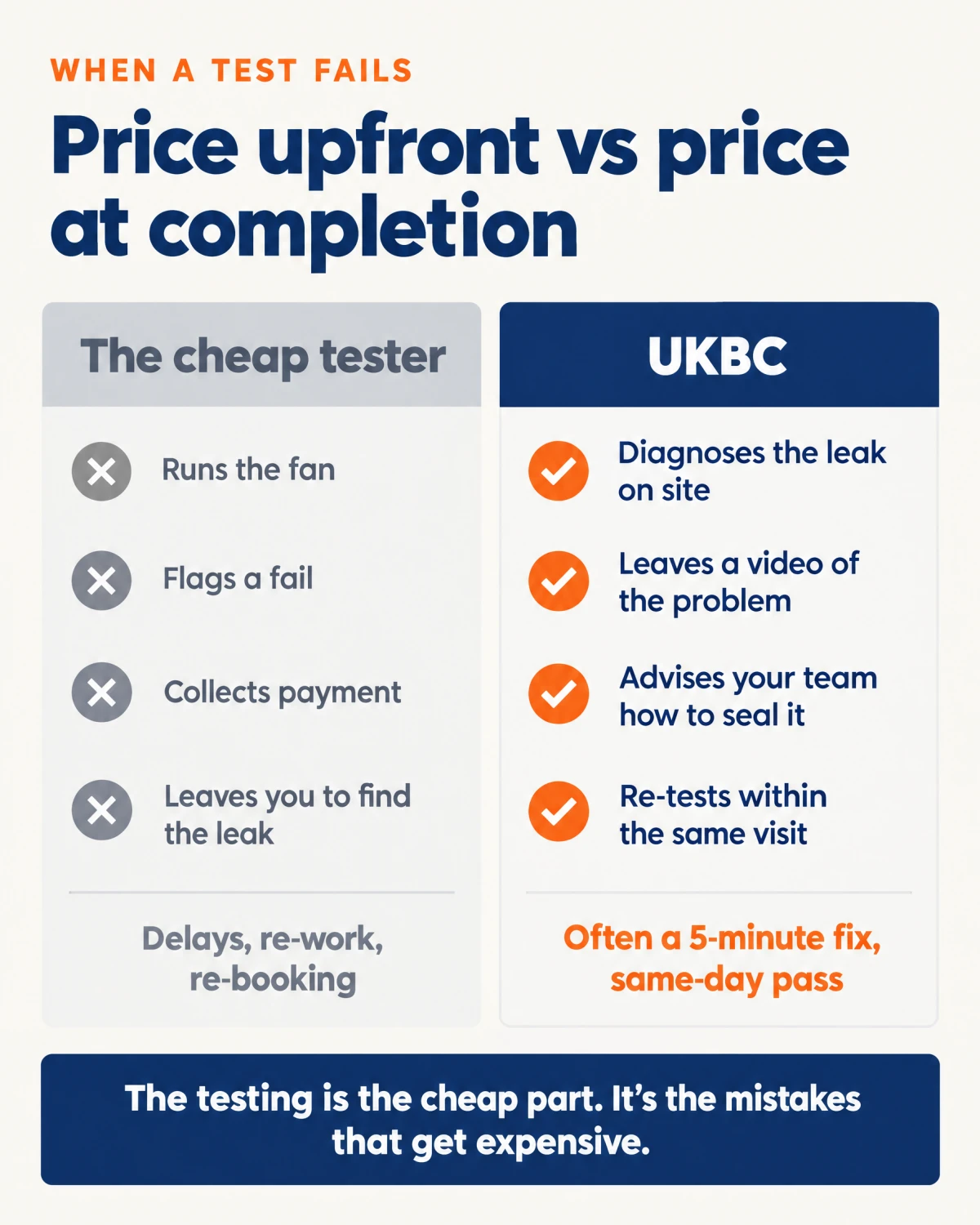
Cheap tester vs UKBC: price upfront vs price at completion
| When the test fails | Cheap tester | UKBC |
|---|---|---|
| Finding the leak | Leaves you to find it | Diagnoses it on site |
| Evidence | A fail result | A video of the problem to re-watch |
| Fixing it | Your team guesses | On-the-spot sealing advice |
| Re-testing | New booking, new visit | Unlimited re-tests within your 2-hour visit |
| Likely outcome | Delays, re-work, re-booking | Often a 5-minute fix and a same-day pass |
How to avoid a failed air test in the first place
Most fails come from a handful of predictable leak paths: unsealed service penetrations, gaps around window and door openings, joist zones and dot-and-dab plasterboard. Two things take most of the risk out:
- Book a first-fix pre-test. Testing before the plasterboard goes up means leaks are cheap to find and fix. Read why first-fix air testing is a smart move.
- Work through the readiness checklist. Our guide on how to pass an air tightness test covers how to prepare the building on the day.
The compliance testing is the cheap part. It’s the mistakes that get expensive. Let’s get it right from the start.
Get an exact, fixed-price quote for your development in just 60 seconds. ATTMA-accredited engineers nationwide, with same-week bookings available.
Frequently asked questions
What happens if a building fails an air tightness test?
The building cannot be signed off by building control until it achieves a compliant result. The leaks have to be found, sealed and the building re-tested. With a tester who only records the result, you rebook and wait. With UKBC, our engineer stays to pinpoint the leakage with on-site diagnostics, advises your team how to seal it and re-tests within the same 2-hour visit at no extra fee.
How much does a failed air test really cost?
The test fee is rarely the expensive part. A failed test can easily add £1,000+ once you count trades on standing time, a delayed building control sign-off that holds up final payments, and remedial work that can mean opening up finished walls to find the leak.
Does every new dwelling need an air tightness test?
Yes. Since Approved Document L 2021 came into force in England, every new dwelling must be air tested. The old sampling approach, where only some plots on a site were tested, no longer applies.
What air permeability score do I need to pass?
The legal maximum for a new dwelling is 8.0 m³/(h·m²) at 50 Pa. In practice your real target is the design air permeability used in your SAP calculation, which is usually much lower. The measured result feeds the as-built SAP, so a score worse than the design figure can put your energy compliance at risk even if it is under 8.0.
Who is allowed to carry out an air tightness test?
Building control expects the test to be carried out by a tester registered with a recognised scheme such as ATTMA (the Air Tightness Testing and Measurement Association) or iATS, and to follow the ATTMA technical standard for the building type. UKBC engineers are ATTMA accredited and work nationwide.
Can you re-test on the same day if my building fails?
Yes. Every UKBC test includes unlimited re-tests within your 2-hour visit, so your team can apply quick fixes and have the test re-run while our engineer is still on site, for no extra fee. Often, a 5-minute fix turns a fail into a same-day pass.